Why I Built Recipro
I didn't want another app that made me log every coffee. I wanted one number that told me where I actually stood — across assets, countries, currencies, and money lent to people I love. So I built it.
Recipro didn't start as a product idea. It started as a personal itch I couldn't scratch with anything that already existed. My wealth was spread across assets, countries, currencies, and a handful of people who owed me — and every tool I tried either asked for far more bookkeeping than I was willing to do, or quietly lied to me about how much I actually had.
This is the story of the problems that made me build it.
I never wanted to track every expense
I've tried the detailed approach. Every time, the pattern was the same: I'd start strong, tag every purchase for a week or two, and then quietly give up. Logging each coffee and reconciling categories at the end of the month is a real strategy for some people — it just isn't mine. It's too much work for something I burn out on by the second month.
Along the way I realized I didn't actually need it. I already have a decent sense of my spending; I don't overspend, and I don't need an app to police me. What I was missing wasn't more detail — it was one honest answer to a bigger question:
Is my total wealth going up or down?
That's the thing I care about. Not where each euro went, but the direction of the whole. Once I noticed I already had that financial awareness, micro-managing every transaction felt like effort spent confirming something I basically already knew.
But "total wealth" is more than what's in my bank
Here's the catch: the direction of my wealth is meaningless if I'm only looking at cash. A big part of what I'm worth doesn't sit in a bank account at all — it's in things. The value of real estate. Investments. A car. To know my real net worth, I had to capture those too, keep their values roughly current, and fold them into the same total as my accounts.
A bank-balance-only view isn't just incomplete — it actively understates where I stand and makes the trend jumpy for no real reason. I wanted assets and accounts adding up to a single figure: everything I own, in one number.
My money doesn't live in one country — or one currency
On top of that, I hold accounts and assets in different countries and different currencies. Individually, each balance is easy enough to read. Together, they were a mess. To understand my real position I had to convert everything into a single currency in my head — and exchange rates move constantly, so the total I calculated on Monday wasn't the total on Friday.
That constant mental conversion was exactly the kind of friction that made me stop checking. And a picture you avoid looking at is worse than no picture at all.
Money I lent kept slipping through the cracks
Then there's the money that isn't even with me. I lend to friends and family — and those loans almost never behave neatly. Someone would take months, sometimes the better part of a year, to pay me back. They'd pay in irregular installments: a bit this month, nothing the next, a chunk later on. There was never a single place that told me where each person stood.
Worse, without one source of truth, I'd sometimes just… forget to charge someone at all. Not out of generosity — out of losing track. The money wasn't really the problem. The ambiguity was: no clear record, no running balance, no way to glance and know.
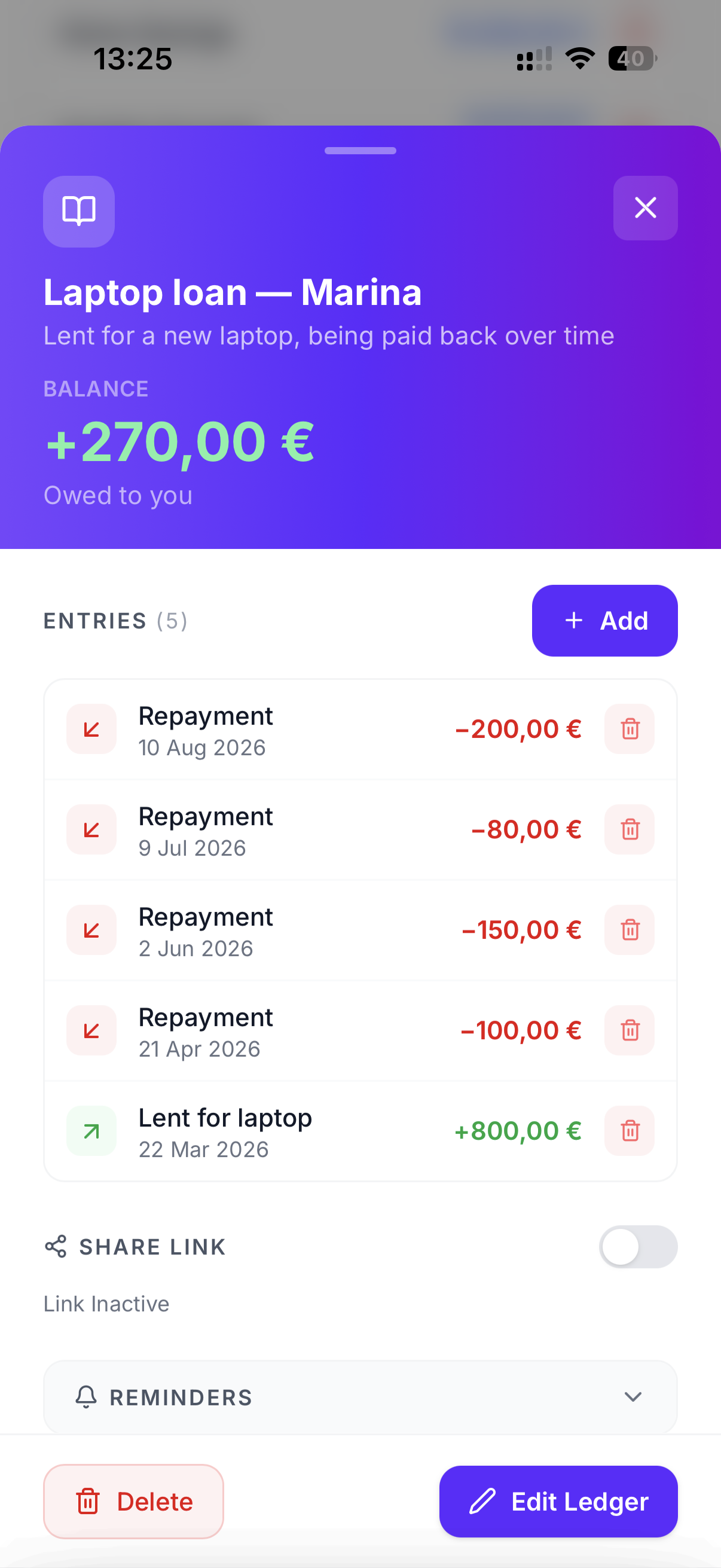
Example: one running balance per person, nudged up or down by each entry as it happens.
Some of my money sits in someone else's account
The trickiest piece: I keep some money in a trusted person's bank account abroad. Every so often I withdraw part of it, or deposit more. And because it's their account, they'll sometimes pay a bill for me straight out of it — which means my balance there quietly drops without me moving any money myself.
Keeping that straight in my head was nearly impossible. It's not a simple "they owe me" or "I owe them" — it flows in both directions, all the time. I needed something that treated it as a living, two-way balance, not a one-off loan with a due date.
Sometimes I want to know how long I could just stop
Every so often I get restless. A job stops being satisfying, or I catch myself itching to chase a new idea, try something different, take an adventure. And the question that decides whether I can actually act on that feeling isn't my salary — it's this:
If the income stopped tomorrow, how many months could I keep going?
That number — my runway — is what turns "I wish" into "I actually could." It's net worth divided by what I spend each month, and having it visible changes everything. Freedom stops being a vague anxiety and becomes a number I can check before I make a leap. It's hard to explore new jobs, ideas, and adventures when you have no idea how much runway is under you.
The whole picture is what actually keeps me calm
Here's the payoff I was chasing: when I can see my total wealth — assets and accounts, plus the money sitting with friends, family, and that account abroad — in one place, my anxiety drops immediately. I can tell in seconds whether things are trending the right way, how much runway I have, and where I should put my attention.
I tried to hold all of this in a spreadsheet. It technically worked, but it was chaotic and messy: formulas I didn't trust, currencies I had to convert by hand, asset values I forgot to update, loan balances scattered across tabs, and a nagging feeling that a number somewhere was stale. Instead of lowering my anxiety, the spreadsheet became another thing to worry about.
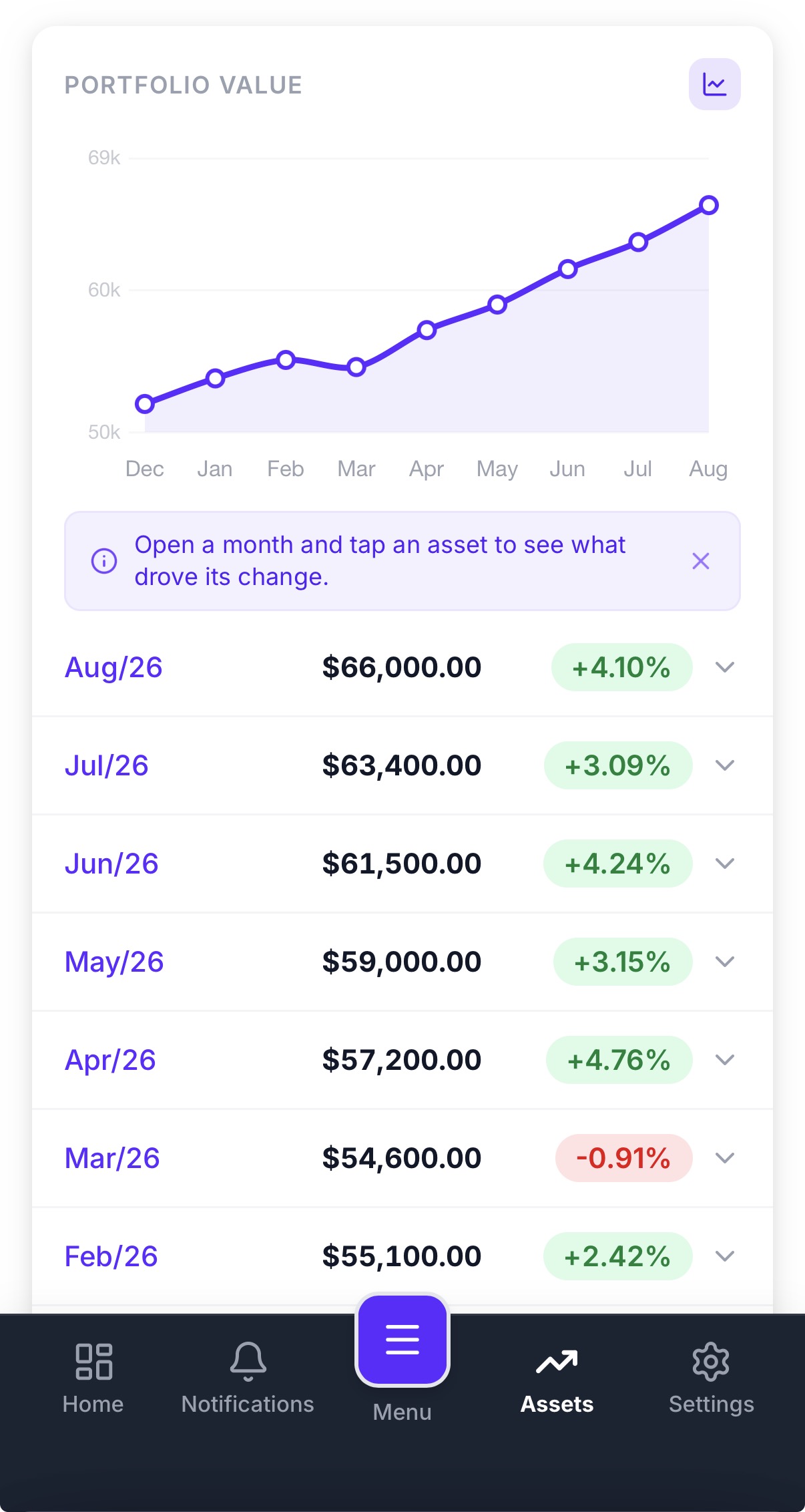
Example: everything scattered across places and currencies, resolved into one honest number.
So I built Recipro
Recipro is the tool I wanted for myself, built around exactly these problems:
- It tracks your whole net worth, not just cash. Real estate, investments, cars, and account balances all live in one place and add up to a single figure — everything you own, in one number.
- It watches the direction, not every transaction. It captures a monthly snapshot of your net worth automatically and plots the trend, so "am I going up or down?" is something you glance at — no expense logging required.
- It's multi-currency by design. Each account and asset keeps its native currency; Recipro converts everything into your home currency for one honest total — and it archives month-end exchange rates so your history stays stable instead of drifting every time the market moves.
- It keeps a running balance for money you lend. Each person or purpose gets a ledger, and every repayment — however irregular, however delayed — is just another entry that chips the balance down. No due dates to miss, and nothing falls through the cracks. Balances go both ways, so that money in someone else's account abroad fits naturally: deposits, withdrawals, and bills they pay for you are all just entries moving one balance up or down.
- It tells you how long you could stop working. A built-in calculator takes your net worth and monthly spending and turns them into a runway — the number of months you could go without income — so exploring a new job or idea starts from facts, not fear.
- It puts the whole picture in one place. Assets, accounts, and money owed to you all roll up into a single number you can read in seconds — the exact thing that keeps my own anxiety low.
That's the whole philosophy: less bookkeeping, more clarity.
If any of these problems sound like yours, a few other posts go deeper on the pieces: the one-time guide to calculating your net worth, the case for tracking the big picture instead of every expense, how multi-currency net worth stays honest, a system for tracking money you lend to friends and family, and how many months you could live on your savings.
I didn't build Recipro to turn anyone into an accountant. I built it because I wanted to stop doing mental math across a house, a car, three countries, and half a dozen IOUs, and just see where I stand — and how far I could go if I wanted to change something. If that sounds familiar, it was built for you too.