How to Track Money You Lend to Friends and Family
Informal loans are easy to forget and awkward to chase. Here's a simple system to keep every IOU straight without souring relationships.
Lending money to people you care about is a quiet source of stress. You rarely write anything down, the amounts feel too small to formalize, and months later nobody quite remembers who paid for what. The money itself is rarely the problem — the ambiguity is.
Here's a lightweight system that keeps informal loans clear without turning your friendships into spreadsheets.
Write it down the moment it happens
The single most valuable habit is recording a loan when it happens, not later. A one-line note — who, how much, what for, and the date — is enough. The goal isn't bookkeeping precision; it's having a shared source of truth so nobody has to rely on memory.
A number you both agreed on at the time is worth more than a perfect estimate reconstructed six months later.
Keep a running balance per person
Instead of tracking individual transactions in isolation, keep a running balance for each person. Every time money flows in either direction, the balance updates:
- You cover a $40 dinner → they owe you $40
- They pay you back $25 → they owe you $15
- They spot you $30 for a cab → now you owe them $15
At any moment, one number tells you where things stand. This is exactly the model Recipro's ledgers use — a simple credit/debit journal per person or purpose, with the balance calculated for you.
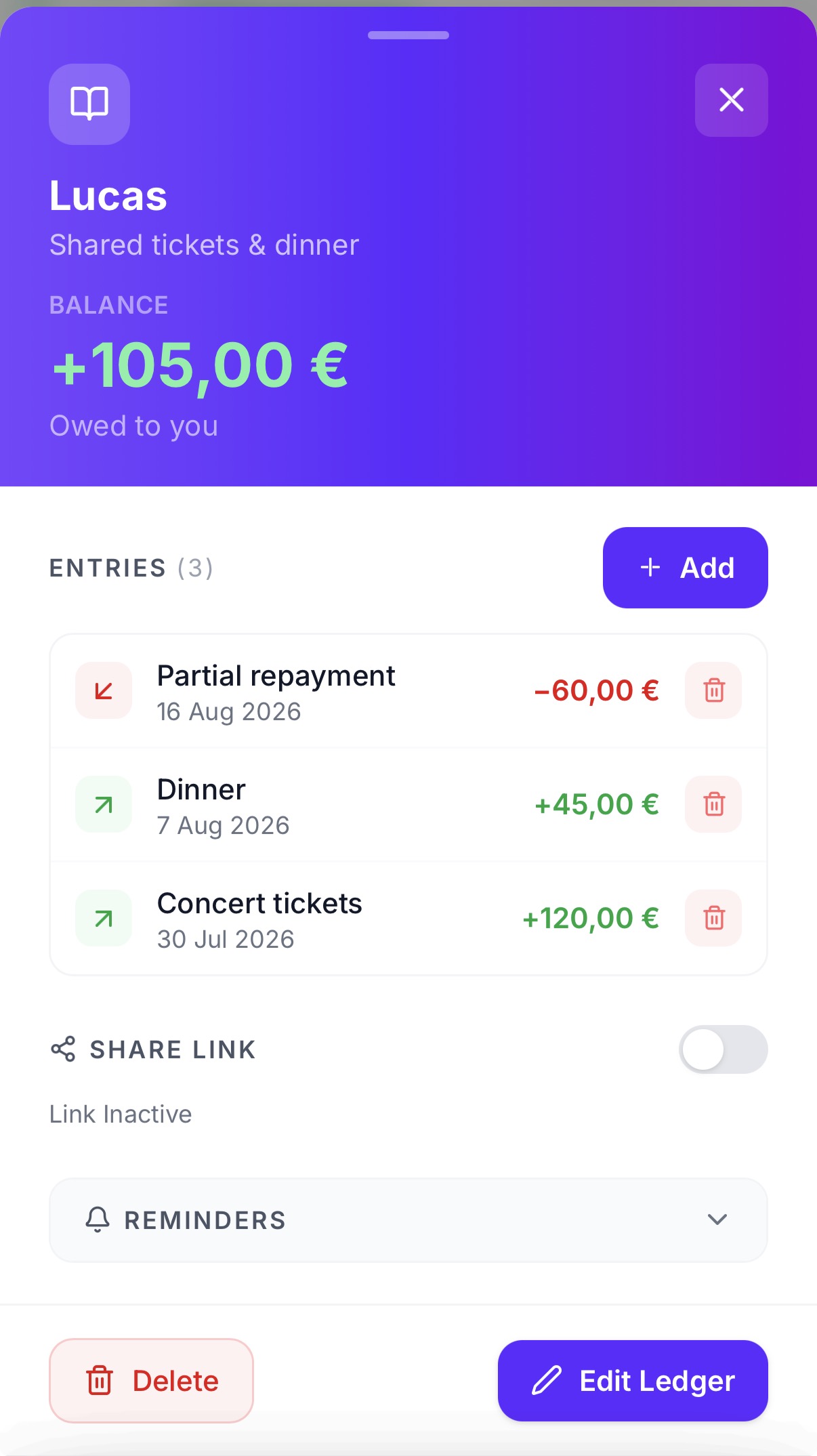
Example: a ledger keeps one running balance per person, updated with every entry.
Share the ledger so nobody's guessing
A running balance is most useful when both people can see it. In Recipro you can turn any ledger into a public, read-only link and send it to the person you lent to — they don't need a Recipro account or the app, just the link. They see the same entries, the same running balance, and the same status you do.
This quietly removes the awkwardness: there's nothing to "bring up" because the numbers are already shared. And you stay in control — the link is view-only, so the other person can't change anything, and you can switch it off at any time to revoke access.
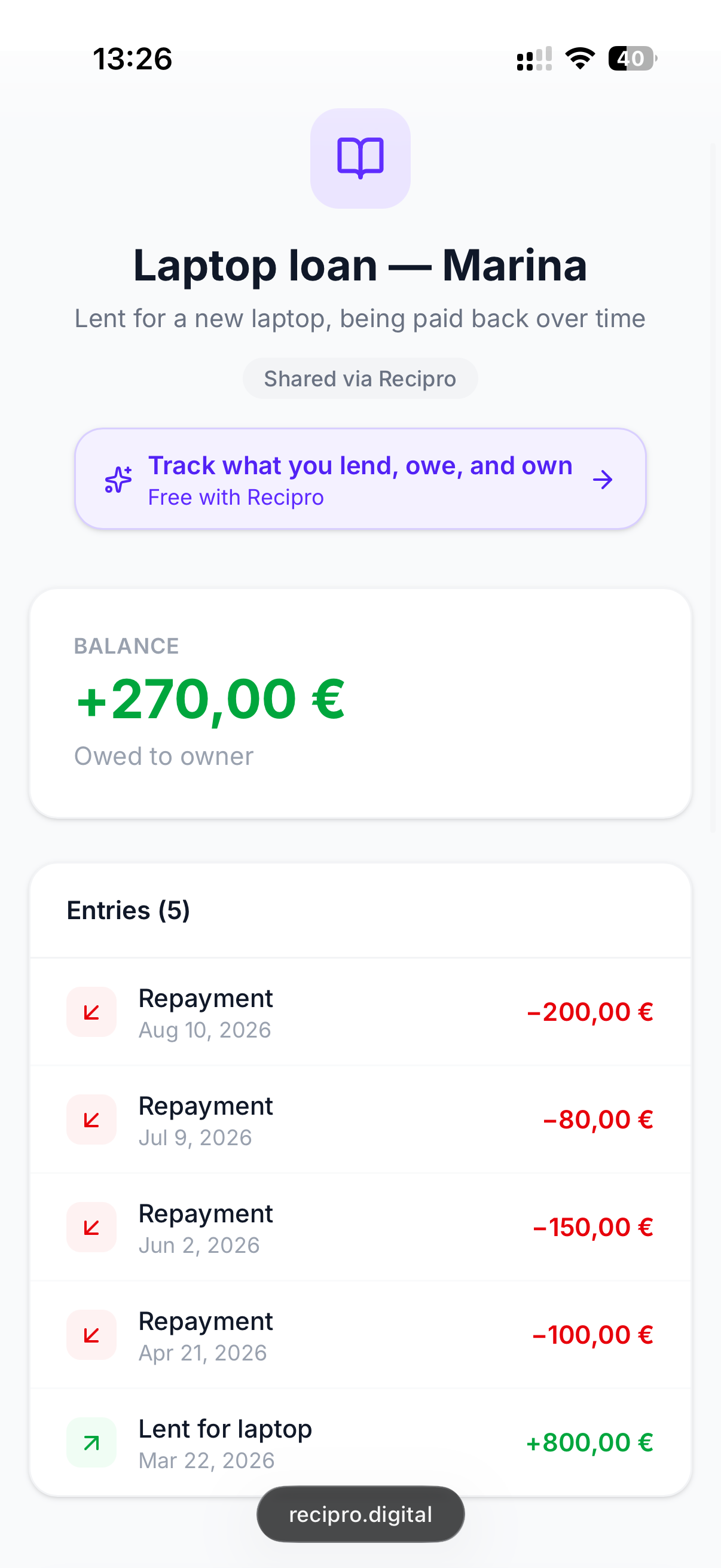
Example: the read-only link the other person opens — same numbers, nothing they can edit.
Separate "shared costs" from "loans"
A common mix-up is treating split expenses the same as loans. They behave differently:
- Loans are money you expect back in full.
- Shared costs are expenses you're dividing — rent, a group gift, a trip.
Keeping them in separate ledgers means a settled trip doesn't get tangled up with the $200 you're still owed from last year.
Settle regularly, not perfectly
You don't need to settle every transaction the day it happens. Pick a natural rhythm — monthly, or at the end of a trip — and square up the balance then. Regular, approximate settling beats rare, exact settling every time.
Built for slow, long-term paybacks
Not every loan gets squared up at the end of a trip. Sometimes you lend to family expecting to be paid back over a long stretch — a year isn't unusual — in whatever installments they can manage. Some months a payment lands; some months they skip a cycle entirely. That's normal.
A running-balance ledger fits precisely because it has no fixed schedule to fall behind on. There are no due dates to miss and no overdue flags — each repayment is simply another entry that chips the balance down whenever it arrives, and a skipped month just means the balance sits unchanged until the next one. The ledger tracks what actually happened, without turning a slow, informal arrangement into something that feels like a missed bill.
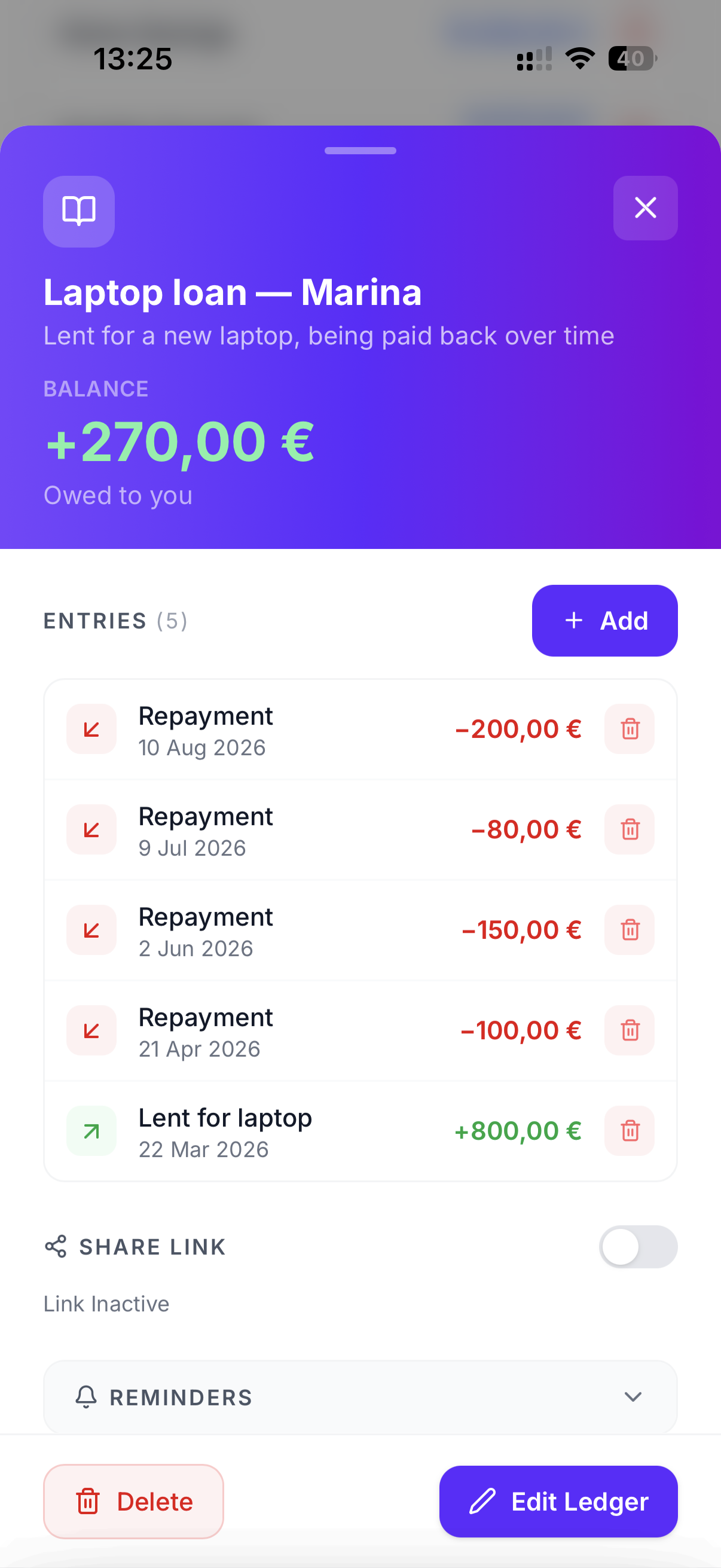
Example: repayments arrive when they can — a skipped month just leaves the balance flat.
Tracking informal money doesn't require discipline so much as a system that removes the need for it. Write it down, keep one balance per person, and settle on a rhythm — and lending to friends stops being something you quietly dread.